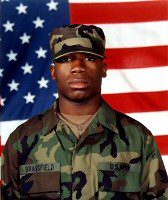
Artimus D. Brassfield
Specialist, United States Army
March 28, 1981 – October 24, 2003
Age – 22
Flint, MI
Operation Iraqi Freedom
B Company, 1st Battalion, 66th Armored Regiment, 4th Infantry Division, Fort Hood, TX
Killed during a mortar attack in Samaria, Iraq
Artimus grew up in Dayton, Ohio, until he moved to Flint to live with his father when he was 14. He was named after Artimus Gordon from the 1960s television show “Wild, Wild West”. He joined the Army in March 2001 after graduating from Flint’s Central High School. He was “happy-go-lucky” and popular and was part of the Kappa League social fraternity in Flint. Artimus struggled in school and failed the military entrance test twice before finally succeeding in enlisting but always kept his focus on two main ambitions: to play basketball and join the military. He made it through high school and got himself together.
Brassfield died of wounds received when a mortar struck nearby while he was playing basketball at a military base at Samaria, Iraq. An explosion had sent soldiers running for cover, but a second shelling ended Artimus’ life before he could reach the nearest building. Artimus died doing what he loved; he loved basketball, and he loved the Army.
His two main ambitions were to play basketball and serve in the military He married his wife, Andrea, in August 2001, just five months after enlisting. He served as a tank driver with B Company, 1st Battalion, 66th Armored Regiment, 4th Infantry Division, based at Fort Hood, Texas
He was posthumously awarded the Purple Heart and Bronze Star for his
Legacy and Remembrance
Brassfield’s death was described by his father as “dying doing what he loved” — basketball and the Army.
In an e-mail interview with Metro Times, Brassfield’s immediate commander, Staff Sgt. William Annussek, provides details that the military’s paid spokespeople and its blizzard of inaccessible paperwork eschew.
“We had a mission in the afternoon [of Oct. 24] and we had to fix the tank,” Annussek writes. “We started early. We finished, and Dutter [the gunnery officer] and I were going to go back to the room. Brass said he was going to talk to his friend, and Dutter and I started walking away. We got about 50 feet away, and a mortar hit. It knocked Dutter and I down. We jumped up and ducked behind a pillar while four more mortars dropped in. We waited a couple of seconds and ran around the weight-room tent.
“There he was, lying next to the weight-room tent with his sunglasses on.”
Annussek says the fact that Brassfield wore shades “saved me a lot of pain, because I realized right away he was killed. We tried to stop the bleeding and carried him to the doctors. They couldn’t help him.
“Hearing the doc say Brass was dead shook me and Dutter up bad. Of course, I was in denial, and just walked to my room and cried for a good three or four hours. My mind was shot and I didn’t know what to do. I felt as a leader and his tank commander that I let him and his family down. In the military, you’re taught to take care of your soldiers and I felt like I failed even though it was uncontrolled.
“You know, you really don’t realize how close you are until it’s gone. Our crew was so tight and loved each other to death.”
Annussek takes solace in the knowledge that death was nearly instantaneous for Brassfield. “I don’t believe he suffered.”
His former platoon leader remembered him. “It was my honor to have been your platoon leader so long ago. I can’t believe it’s been 10 years. The fond memories I have of your bright smiling face and positive attitude always boosted our moral back then and those memories have kept me serving all these years later. I had thought once or twice of leaving the Army for good but having the opportunity to serve great Soldiers like you is what has kept me going and I can think of no other occupation that gives the same satisfaction. The satisfaction of training, serving, and leading great men like you. Selfless men like you. One of the last memories I have of serving you was getting to re-enlist you while we were in Iraq. Imagine that, in the worst of all places and the craziest of times, you chose then to raise your right hand again and commit to your country for more years. I have a picture of you and me that day on my desk which reminds me of all the Great Soldiers I have had the honor of working with. It is you who has reminded me at each tough leadership decision just who it is the officer corps serves and you who has guided me through company command and multiple deployments. You were there every time.
Tomorrow morning I will run my 7th Army 10 Miler in Washington DC and I am dedicating this run to you and your family. I’m anticipating a personal best time, but just knowing you and the other fallen are always running with me is all I will ever need”.